Tag Archives: Netflix

Time and the Gunwitch

Have I ever mentioned how much I hate time travel stories?

Okay, there’s Doctor Who, but that treats time the same way Star Trek treats space: it’s a way of getting between adventures. And it never really treats its time travel very seriously anyway, and that’s usually the only way I can stomach time travel plots.

It isn’t that time travel makes for bad stories, it’s more that you need a really good writer to avoid turning a time travel story into one, huge, horrible, gaping plot hole. It’s especially bad when TV writers get their hands on the idea. I have never seen time travel done on TV, seriously, in any manner worth watching. It’s kind of annoying. Films don’t generally do better. I think the problem is that it’s really hard to write something involving time travel, that’s the typical kind where the time travellers are changing things, where you don’t need degrees in physics and philosophy to put it all together without making it sound stupid.

Let’s take the classic one as an example. It’s been used in a fair number of books and films, and it’s the basis for many more. Ray Bradbury’s A Sound of Thunder. I know, venerable science fiction author, big deal. I shouldn’t be going there, but… it just makes no damn sense. Time travel is used by people with more money than sense to go back in time so that they can hunt dinosaurs. They must be very careful not to change anything important (they hunt dinosaurs which are going to die soon after anyway) because tiny changes can cause unforeseen and massive changes back in the present. Someone steps on a butterfly and the world changes. Frequently the story is represented as bringing the dinosaurs back, but that’s not what actually happens in the original story, just in many of the remakes.

So, what’s the problem? Well, in the original story the changes are too subtle, or too extreme, depending on your point of view. Human society has been changed by the death of a single butterfly. Even assuming large-scale chaos theory-type conditions, changes to human society are too subtle while the probability that humans would be wiped out, along with the time travel system seems both unlikely and yet more realistic. If you switch it and bring the dinosaurs back, well, that’s beyond ludicrous: the dinosaurs were wiped out by large-scale climate change, possibly involving a huge meteorite impact: if you can stop a space rock hitting Earth by stepping on a butterfly… Well, just no.

Other plots tend to leave gaping holes, or be illogical. I’ve been enjoying The Flash recently. Good series, I like it. However, the time travel stuff thus far has had more holes in it than I care to think about. What got me into writing this post was a film I just watched on Netflix called ARQ. That features a Groundhog Day-style time loop, but it’s done very seriously and those only ever work played for laughs. (For the record, Xena and Stargate SG1 have done Groundhog Day episodes that I thoroughly enjoyed, but they were played for laughs, which is the w I like it.) Also, I was discussing time travel stories with a friend recently and I mentioned that I had written a time travel story once and I had reread it very recently…

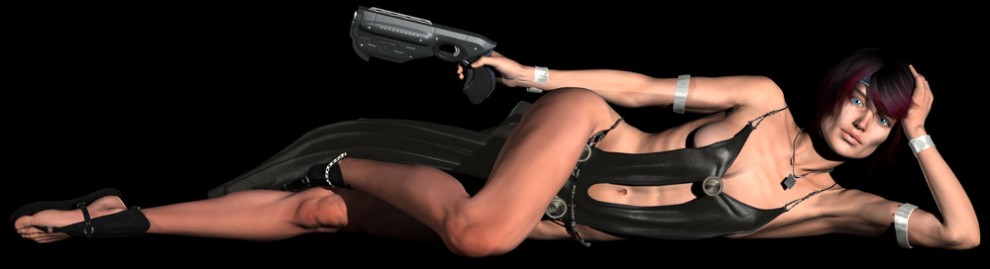
And that gets me to the Gunwitch. She was a character I created for the Going Rogue supplement to the City of Heroes MMO. As with many of the characters I created for that game, bits of her have made it into my books, but I did a lot of pretty good stuff for Gunny and I was reminded of her recently. She was definitely one of my favourite characters and I decided that I was going to bring her back from video game oblivion. The setting had to change, of course, which does change the character a little, but I can get pretty much all that Gunwitch goodness out. Assuming nothing goes wrong – and it’s going pretty well so far – the first book will be out November/December and will be called Gunwitch: Rebirth for two reasons, one in-continuity and the other because I’m bringing her back for the book.

And one of the Gunwitch stories I won’t be doing again, sadly, is one I called Murder in the Orchard. In that one our plucky heroine is sent back in time to 1927 to investigate a string of mysterious murders which happened in an English country village. They know they have to send her back because (drum roll) they have a picture of her taken in 1927 at one of the crime scenes, so she has already investigated the crimes, she just needs to get there to do it. It was a closed loop time travel story; going back in time was simply fulfilling history which was known to have happened. It’s one of the few kinds of time travel plot I can handle without my teeth itching. Plus… I really wanted to write an English cosy mystery story with a sci-fi element…

Anyway, another wall of text there, I feel you deserve a picture so here’s the latest concept art for the Gunwitch. There will be more about her later, but that’s what you’re getting for now.

gunwitch-pinup18

Cliffhangers in the Age of Netflix

Three posts in a day, I must be on something. I think it’s insomnia and compensatory coffee, but I’m not sure. Sorry for this, I’m ranting again. But at least it’s more genre-related.

Anyway, the cliffhanger. Cliffhanger endings are beloved of comic book fans and the writers of those serials they ran back in the dark ages like Flash Gordon and King of the Rocket Men. Well, beloved of writers and there’s a rather more mixed reaction from fans, but this kind of ‘our hero is about to die, find out what happens next week’ ending is sort of expected. I put the epilogues in the Ultrahuman books as a sort of homage to this. That’s a homage. I tend to prefer not to write actual cliffhanger endings to books because, let’s be frank, it drives me crazy when someone does it to me.

We see this in modern television and some film series. (I can trace this back to my annoyance with the ending of The Empire Strikes Back for sure.) Now, I grew up with Doctor Who which rarely did a single episode story back then. It used to run 25 minutes and a typical story was 4 or 6 episodes, airing at tea time on a Saturday. You’d have cliffhangers all the way through until the last episode, but you only had to wait a week for the next episode. The modern series rarely does a 2-parter, but does usually have a season arc. That’s fairly kind compared to six weeks of biting your nails. What modern Doctor Who does not do, but an enormous number of modern US TV series does, is the season finale cliffhanger.

I want to find the idiot who came up with this idea and make him watch 365 continues days of reality TV. I know why they do it. I understand. You’ve built an audience and you’ve probably watched the figures trailing downward through the season (seems to happen to the best shows), and you want them to come back for season two. So you put a hook at the end to make them come back to find out the resolution and hope that they’re hooked again and you keep them through the season. If I recall US scheduling right, this might even seem reasonable there because there’s a couple of months between seasons. In the UK, we waited at least half a year to find out what happens next. That doesn’t work. We’ve forgotten what the ending was by the time the new season rolls around so the only thing keeping us coming back is that we were fans or there’s nothing else to watch. And the same is true on Netflix.

I have both Amazon Prime and Netflix because there are shows I want to watch exclusive to one or the other. Sleepy Hollow showed up on Amazon and I quite enjoyed the first season, right up until the end. No second season available, I couldn’t find out what happened, even though I’d just binged on the thing. Frustration. The second season has been on Amazon for a while now and I haven’t watched it. Why? Because I stopped caring months ago. I started watching Grimm on live TV and was annoyed at the end of season one. Then 3 or 4 seasons turned up on Netflix and I binge-watched them… right up to the second to last episode. The last was the wedding and I knew there was going to be a cliffhanger I was not going to resolve. Grimm has probably lost my attention now because by the time the next season is available, the episode I didn’t watch will not be.

The season end cliffhanger just doesn’t work in the era on binge-watching and boxed sets. We’ve been shown we can have instant gratification, and then it’s ripped away from us. Netflix themselves seem to have recognised this. Daredevil, the first season anyway, resolves its main storyline at the end and season two brings in a new antagonist. Jessica Jones, which I still haven’t got to the end of, seems to be going the same way. Even their thoroughly amusing Puss in Boots series avoided straining your patience. Netflix realise that their model doesn’t need cliffhangers. If you watched season one, they push season two at you for weeks ahead of the first show and it goes right to the head of your ‘continue watching’ list with a ‘new episodes’ tag. If you were hooked, they’ll probably grab you again.

Last night, I discovered that Netflix had the first two seasons of iZombie. I’d seen trailers for this on DC’s YouTube channel and thought it looked like fun. It is. (If you haven’t tried it, give it a go. It’s got zombies, drama, and my kind of sense of humour. If you tried it and hated it… Can’t please everyone.) Later this evening, probably over dinner, I’ll watch the first season finale and if it’s a cliffhanger I may decide to scream, but at least I can go straight on to season two. But then I don’t know when season three will turn up… Please, please, won’t someone bring an end to the horror of the end of season cliffhanger!

Anyway, that’s why I don’t hang my readers off a cliff at the end of my books, even with my production rate. Lucifer is the only show I’ve seen on Amazon which handles this well. The end of season one was… cliffhangerish, but it was a little more like my Ultrahumans epilogues, a tease for what’s going to come next rather than a real cliffhanger. That’s a start.

Have a great day. Without cliffhangers.

PS. I’d personally recommend Lucifer. Strong start, a little rocky after that, but it rapidly improves again. However, if you’re a fan of the original comics, take my recommendation with a pinch of salt. Comic and series are not the same, and I know how that annoys some people. Hell, Gotham annoys me for all the backstory retcons and I still haven’t figured out why.

PPS. Just watched the iZombie season finale. Bloody cliffhanger. Oh well, it’s amusing enough I’ll probably cope at the end of season two. *sigh*


Reality Hack – Still Not Sure About the Genre

So, Reality Hack is due out on the 4th of July and I’m still not sure which genre it sits in. I hate genre classifications and it’s always been clear to me that those responsible for such classifications know not what they are talking about. Please allow me to vent…

If I go to Netflix or Amazon Prime Video, and I go looking for a science -fiction movie, I am going to find myself looking at a load of fantasy, some horror, quite a bit of romance that has a vague hint of sci-fi about it. (Well, with Netflix’s idea of classification, looking for a sci-fi movie is an exercise in frustration anyway, but the general idea is the same.) These companies classify everything with any form of fantastic basis as the same genre. I can’t help but wonder whether this general lack of clarity bothers other people as much as it does me? I mean, if they have to split things into groups, could they not do the job properly?

Meanwhile, the book publishers are worse. They want their books classified into increasingly narrow bands of genre, but they haven’t a clue what the genres mean. The Game of Thrones books are not science fiction. Twilight is not science fiction, but of course that august work more or less defined a genre which spawned from some publisher’s desire to corner a market, the ‘Young Adult’ genre. (I believe that YA actually stands for ‘Youthful Angst,’ but that may be just me.)

The genres they create usually don’t work for real books. You take the series I’ve been reading a lot of recently, J.D. Robb’s In Death books. These are police procedurals, set in a high-sci-fi near-future, with a fairly high romance/erotic content. Well they don’t get classed as erotica, or ‘adult,’ but they do get a load of other categories lumped on them. The aforementioned Game of Thrones: is that political thriller or grim, ultra-low fantasy?

So, I’m having difficulty with Reality Hack. It’s clearly urban/contemporary fantasy, being to do with magic and the supernatural in a modern setting, but I’m inclined to avoid that area since there’s no romance involving vampires. It has some distinct horror elements (and if it gets a sequel there will be more of that). The actual setting has some heavy science fiction elements to it as one might expect of a book called Reality Hack. There is romance and sex, yes, but there’s also some twisted psychology, and drama, and questions about the nature of reality, and I have to pick a couple of narrow slots to drop this complex tin of worms into.

Don’t get me wrong: without those tight little boxes I doubt anyone would have noticed Steel Beneath the Skin and most of you would not be reading this blog. It’s just that around the time when I have to decide what box to put a book in, I sort of long for the time when it was just ‘fiction’ and ‘non-fiction.’